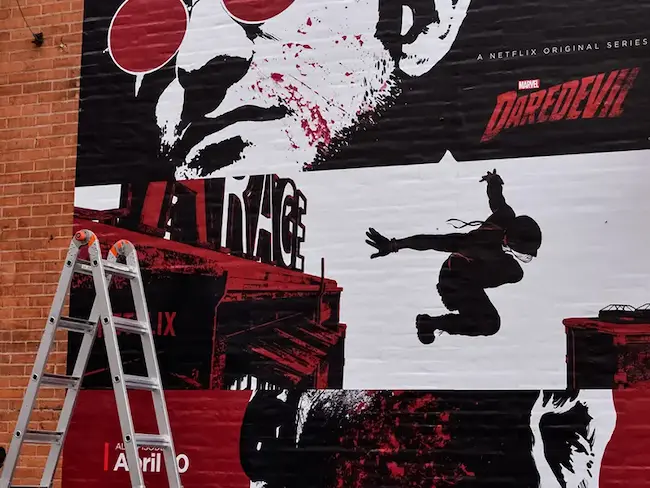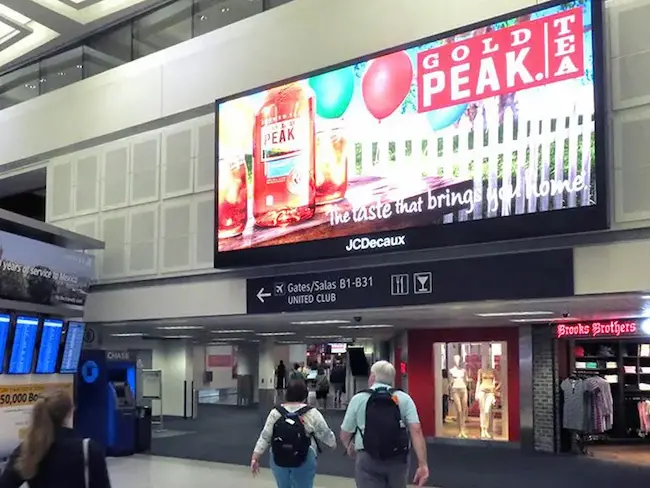
The reach of Trackie’s work continues to grow as his printed prose and remixed visual language resonate with tens of thousands of people online and in the physical world. His messages function across multiple spaces — when encountered in a gallery, shared through an Instagram story, or seen unexpectedly on the streets of London. What makes the work powerful is not scale alone, but how it connects emotionally wherever it appears.
When a billboard becomes a conversation
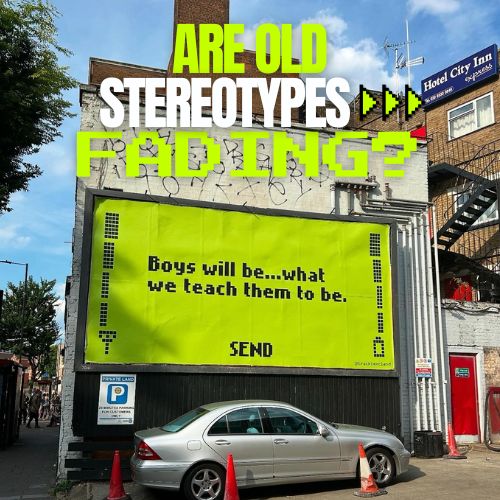
One of Trackie’s most impactful pieces emerged through a billboard collaboration with BUILDHOLLYWOOD. The execution featured a flyposted graphic styled like a Nokia 3310, emblazoned with the phrase “Boys will be what we teach them to be.” The message reframes masculinity as something learned, reinforced, and performed rather than fixed or inherited.
Placed in public space rather than on a gallery wall, the message reaches people in moments of everyday movement. It interrupts routine, catches attention unexpectedly, and invites reflection in environments where art rarely speaks directly to broad audiences.
Art designed for public interruption
This work is not designed for pristine white walls or controlled exhibition settings. It belongs in the street, where meaning emerges through surprise, friction, and shared visibility. The placement allows the message to collide naturally with daily life, creating conversations that formal art spaces often struggle to generate.
The streets become an extension of the artwork itself, transforming ordinary commutes and casual walks into moments of cultural engagement. The power of the piece lies in how it reaches people who may never intentionally seek out galleries or curated spaces.
Rejecting institutional boundaries
Trackie avoids centering traditional art institutions or gatekeepers within his narrative. His work resists hierarchy and exclusivity, favoring accessibility and emotional honesty over prestige. By working in public environments, the artist reframes who art is for and where meaningful cultural dialogue can exist.
Out-of-home environments offer a democratic platform where messages do not require permission or validation to be experienced. The audience is not filtered — it is simply the city itself.
The economic reality behind independent art
Behind the growing visibility lies a difficult economic reality. Studio space, materials, production costs, and time create constant pressure for working-class artists. Without financial safety nets or institutional backing, every project requires resourcefulness, resilience, and sacrifice.
Trackie speaks candidly about how financial limitations shape creative opportunity. Even when visibility increases, stability does not automatically follow. The work exists within systems that often reward privilege rather than persistence.
Why this matters for modern OOH
This collaboration illustrates how out-of-home media can operate as cultural infrastructure rather than purely commercial space. When public platforms amplify authentic voices and meaningful messages, they generate emotional connection, reflection, and social dialogue.
Trackie’s work demonstrates that sometimes the most powerful advertising space is not used to sell, but to challenge, humanize, and invite people to think differently as they move through the city.
FAQs about this campaign
What is the modern masculinity billboard about?
It’s a BUILDHOLLYWOOD collaboration with artist Trackie featuring a Nokia-style flyposted design that reads “Boys will be what we teach them to be,” highlighting that masculinity is learned, reinforced, and performed.
Why is this message powerful in public space?
Because street placement creates interruption and accessibility, reaching everyday audiences and sparking conversations that galleries and curated spaces often don’t.
What makes the creative recognizable?
The piece uses a retro Nokia 3310-inspired interface and pixel-style typography, including a “SEND” prompt that frames the message like a shared text.
How does this relate to OOH and culture?
It shows how OOH can function as cultural infrastructure, using city walls and billboards to distribute ideas, not just advertisements.
What challenge does Trackie highlight behind the work?
Trackie points to the financial reality facing working-class artists — studio space, materials, and time add up, and without backing, sustainability becomes the biggest barrier.
Craft emotive OOH that resonates
Explore high-visibility print and OOH formats that elevate brand values and recall.
Comments
Be the first to comment.