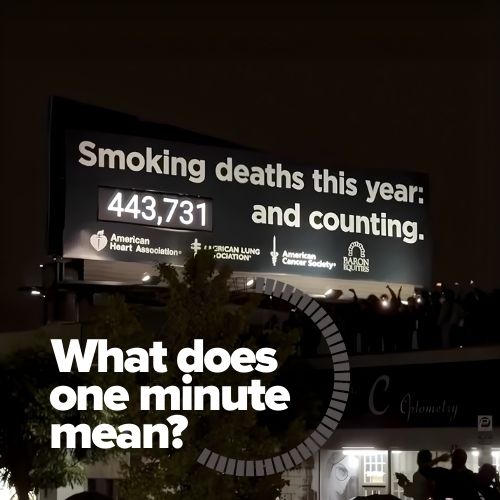
This billboard doesn’t promote a brand, a product, or an offer. Instead, it delivers a message that grows heavier by the second. Displaying the line “Smoking deaths this year: and counting.” alongside a live counter, the execution turns a familiar out-of-home format into a real-time confrontation with reality.
A number that refuses to stand still
Unlike traditional public health messaging that relies on annual statistics, this billboard introduces time as an active element. The counter is not symbolic—it implies movement, inevitability, and urgency. Every passing moment suggests that the number is rising whether we are watching or not.
By presenting smoking-related deaths as something that is actively unfolding, the campaign removes emotional distance. This is not history. It is now.
Minimal design, maximum weight
Visually, the execution is striking in its restraint. A dark background. Bold white typography. A single illuminated digit. There are no graphic images, no dramatic visuals, and no sensational language.
That restraint is precisely what makes the message powerful. In a cityscape filled with color, animation, and promotional noise, the silence of the design forces attention. The viewer has nothing to focus on except the meaning of the number.
@jennytuell14 happy new year! #losangeles #community #newyears #newyearseve #2026 ♬ original sound - Jenny Tuell
Authority over shock
The presence of organizations such as the American Heart Association and the American Lung Association grounds the message in credibility rather than provocation. This is not designed to shock for shock’s sake, but to inform with authority.
The campaign positions itself clearly as a public health intervention, not an opinion. The data-led approach reinforces trust and removes ambiguity about intent.
Why out-of-home is essential to this message
This idea works because it exists in public space. Out-of-home advertising forces shared exposure—people encounter the message during commutes, evenings out, and everyday routines. These are moments where the message cannot be skipped, closed, or scrolled past.
The billboard occupies physical space and time, mirroring the reality it represents. Just as the counter keeps running, the message remains present.
Redefining impact in outdoor advertising
By counting lives instead of impressions, this campaign reframes what “impact” means in outdoor advertising. It demonstrates that OOH can do more than persuade—it can confront, educate, and provoke reflection.
In an industry often focused on visibility and reach, this billboard reminds us that the most powerful messages are sometimes the simplest ones, delivered honestly, publicly, and without distraction.
FAQs about this campaign
What is the smoking deaths billboard?
It is a public health billboard that displays a live counter showing the number of smoking-related deaths, updated in real time.
Why is the live counter important?
Because it transforms abstract annual statistics into an immediate, ongoing reality that viewers experience in the moment.
How does OOH strengthen the message?
Placed in public space, the billboard cannot be skipped or ignored, making the message more confronting and memorable.
Who supports this type of campaign?
Public health organizations focused on heart and lung health commonly back initiatives like this to raise awareness.
What can brands and planners learn from this?
That outdoor advertising can deliver meaningful impact by using simplicity, data, and context to communicate urgent truths.
Craft emotive OOH that resonates
Explore high-visibility print and OOH formats that elevate brand values and recall.
Comments