When a joke becomes a campaign
In a world where brands constantly chase attention, McDonald’s New Zealand decided to do something different: listen. What started as a playful idea online quickly evolved into a full campaign that blurred the line between internet culture and real-life activation.
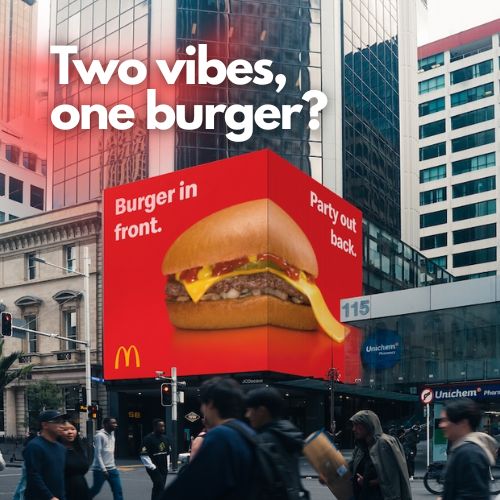
Following the legacy of localized menu innovations like Canada’s McLobster and Mexico’s McMolletes, New Zealand introduced something far less expected but far more culturally charged: the Cheeseburger with a Mullet. And despite the timing, this was not an April Fools’ stunt. It was a real test, powered by fan behavior and executed at speed.
From social buzz to cultural moment
The campaign began with a simple, almost absurd concept: adding an extra slice of cheese to the back of a cheeseburger. The internet did what it does best. Fans embraced the idea, shared their own versions, and gave it a name that stuck: the McMullet.
What makes this campaign interesting is not the product itself, but how quickly it moved from passive content to active participation. Agencies like McCann New Zealand, FleishmanHillard Aotearoa, and OMD New Zealand amplified the idea through social media, influencers, and targeted OOH placements, transforming a niche joke into a national conversation.

Turning engagement into experience
Instead of stopping at digital traction, the brand took the idea offline. At a McDonald’s location in Penrose, the campaign became a live activation. Customers who showed up with a mullet haircut were rewarded with a free Cheeseburger with a Mullet.
For those not yet committed to the look, the experience went even further. On-site barbers were available to give customers a mullet on the spot, turning curiosity into participation and making the campaign impossible to ignore.
This is where the campaign shifts from being clever to being effective. It creates a physical moment tied directly to a cultural symbol, making the brand part of the story rather than just the narrator.
Gen Z, identity, and the power of absurdity
At the core of this campaign is a deep understanding of how Gen Z engages with brands. The mullet, once considered outdated, has been reinterpreted as a symbol of individuality and irony. By embracing it, McDonald’s tapped into a cultural code that resonates far beyond the product itself.
The Cheeseburger with a Mullet is not about taste innovation. It is about identity, humor, and participation. It invites people to be part of something slightly ridiculous, which in today’s content landscape is often exactly what drives sharing and engagement.

Why this campaign works
This campaign succeeds because it follows the audience instead of leading it. It starts with real reactions, builds momentum through social validation, and then amplifies it with physical and outdoor touchpoints.
It also reinforces a key principle in modern marketing: not every campaign needs to be polished or serious. Sometimes, the most effective ideas are the ones that feel spontaneous, self-aware, and rooted in culture.
By combining social media, influencers, OOH, and live activation, McDonald’s created a multi-channel experience that feels cohesive without being forced. It is a reminder that when a campaign feels like something people would do anyway, it stops being advertising and starts becoming culture.
The takeaway for brands
The Cheeseburger with a Mullet is a clear example of how brands can turn small ideas into big moments. It shows the value of listening to audiences, acting quickly, and not being afraid to embrace humor and absurdity.
In a landscape saturated with content, the campaigns that stand out are not always the most complex. They are the ones that connect, invite participation, and give people something worth sharing.
And sometimes, all it takes is a slice of cheese in the wrong place to get it right.
Summary
McDonald’s New Zealand transformed a playful online idea into a full campaign by embracing fan creativity. The “McMullet” started on social media and quickly gained traction, leading to a real-world activation at a Penrose location. With support from McCann, FleishmanHillard, and OMD, the campaign expanded into influencers and OOH. It resonated with Gen Z by tapping into humor, identity, and participatory culture. The result is a strong example of how brands can turn internet trends into real engagement.
Sources
Frequently Asked Questions
The McMullet is a cheeseburger with an extra slice of cheese placed at the back, inspired by the mullet haircut style.
No, despite launching in April, it was a real campaign with a live activation and limited trial.
It began on social media, where fans created and shared their own versions of the idea, driving organic engagement.
Its success came from combining user-generated content, cultural relevance, and a seamless transition from digital to real-world experience.
Yes, the campaign expanded beyond social media to include targeted OOH placements and a physical activation event.
Ready to advertise outdoors?
BM Outdoor plans, buys and prints OOH campaigns across all 50 states. Request a free quote with no commitment.



Comments
Be the first to comment.