The end of Stranger Things isn’t being announced through release dates or traditional trailers alone. Instead, the series is saying goodbye by returning to one of its most powerful storytelling tools: music.
In a joint campaign, Netflix and Spotify transform the show’s soundtrack into a shared emotional memory—using sound not as background, but as narrative.
A soundtrack that became cultural memory
From its very first season, Stranger Things proved that music could transcend the screen. Songs from the 1980s didn’t just accompany scenes; they re-entered global culture as generational touchpoints.
Tracks resurfaced on charts, dominated playlists, and became inseparable from specific moments in the story—turning sound into a lasting emotional imprint.
Looking back before closing the story
This final campaign leans directly into that legacy. Rather than pushing audiences forward, it invites them to look back—revisiting Hawkins through the songs that defined the series’ most emotional arcs.
Memory becomes the entry point to farewell, allowing fans to reconnect with the story before its conclusion.
When music tells the story better than words
At the heart of the campaign is a curated playlist on Spotify, designed as an emotional timeline rather than a simple compilation.
Each song represents a chapter: tension, nostalgia, loss, friendship, escape. Before closing the story, the audience is invited to relive it through sound.
Music becomes a bridge between memory and farewell, reconnecting fans with the series on a deeply personal level.
Music as narrative architecture
Developed alongside Dude Milan, the project reinforces a strategic approach that treats music as narrative architecture—not promotional support.
The soundtrack doesn’t decorate the campaign; it defines it.
OOH as an emotional amplifier
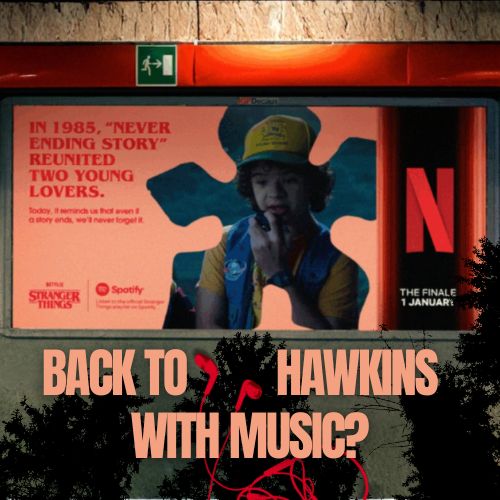
Beyond digital platforms, the campaign extends into out-of-home (OOH) executions that give physical presence to an intangible feeling.
By translating songs into visual and spatial reminders, nostalgia moves from headphones into the real world.
These placements don’t reveal plot points or spoilers. Instead, they function as emotional cues—prompting recognition, memory, and reflection.
A strategic goodbye built on emotion
What sets this campaign apart is its restraint. There’s no over-explanation, no heavy messaging.
The collaboration trusts the audience’s emotional intelligence, allowing music to do the work that dialogue no longer needs to do.
In an era of constant content noise, Netflix and Spotify demonstrate that sometimes the most powerful marketing move is not saying more—but letting people feel more.
FAQs about this campaign
What is the Netflix x Spotify Stranger Things campaign?
It’s a collaborative campaign that turns the Stranger Things soundtrack into a collective farewell, using playlists and OOH to tell the story through music.
Why focus on music for the farewell?
Because music has been a core storytelling element of Stranger Things, with songs becoming cultural touchpoints that connect generations.
How is Spotify used in the campaign?
Spotify hosts a curated playlist designed as an emotional timeline, allowing fans to relive key moments of the series through sound.
What role does OOH play?
OOH executions translate the soundtrack into physical, visual reminders in the city, turning nostalgia into a shared public experience.
What can brands learn from this campaign?
That emotional storytelling—when aligned with culture and memory—can be more powerful than traditional promotion, especially when music leads the narrative.
Craft emotive OOH that resonates
Explore high-visibility print and OOH formats that elevate brand values and recall.